

3D printing technology has become an important method for the research, development, and manufacturing of aerospace engines. With the advancement of AI technology, the aerospace sector is now integrating these two technologies for innovative development.

In 2022, EOS made a groundbreaking display of two aerospike rocket engines created using computer algorithms, artificial intelligence, and 3D printing technology. Although they were just demonstration pieces, they caused a stir at the time, marking the first-ever rocket engine structure in the aerospace and 3D printing industries to be created by artificial intelligence.
The engine is highly complex, standing 80 cm tall, with a high length-to-diameter ratio, thin walls, a honeycomb lattice structure, and regenerative cooling channels. Both partners have stated that combining this level of design complexity with the reliable printing capabilities at this scale will drive new innovations. EOS used the M400-4 and AMCM M4K systems to print versions made from IN718 and copper alloys.

The LEAP 71 team achieved a major milestone in late 2024 by becoming the first to test a 3D-printed aerospike rocket engine designed using AI. This was a breakthrough that had previously taken years for human engineers to accomplish, but the LEAP 71 team completed it in just three weeks. They used the latest Noyron large-scale computational engineering model to develop and 3D-print the aerospike rocket engine, which uses liquid oxygen and kerosene as fuel and delivers a thrust of 5000N.
By late 2025, the LEAP 71 team made another significant advancement, designing and producing a 20kN thrust aerospike liquid oxygen-methane rocket engine, which successfully underwent a hot fire test.
LEAP 71 has become one of the most prominent names globally in the bold pursuit of developing rocket engines using AI and 3D printing. The aerospike engine, hailed as the next-generation propulsion system for space exploration, went from initial concept to hot-fire testing in just three weeks.

The engine design seamlessly integrated manufacturing considerations from the very beginning. LEAP 71 fed the manufacturing constraints of 3D printing directly into the Noyron LEAP 71 computational engineering model. This model then generated an optimized design tailored for 3D printing characteristics. This approach significantly reduced the number of design iterations, leading to a high success rate on the first attempt.
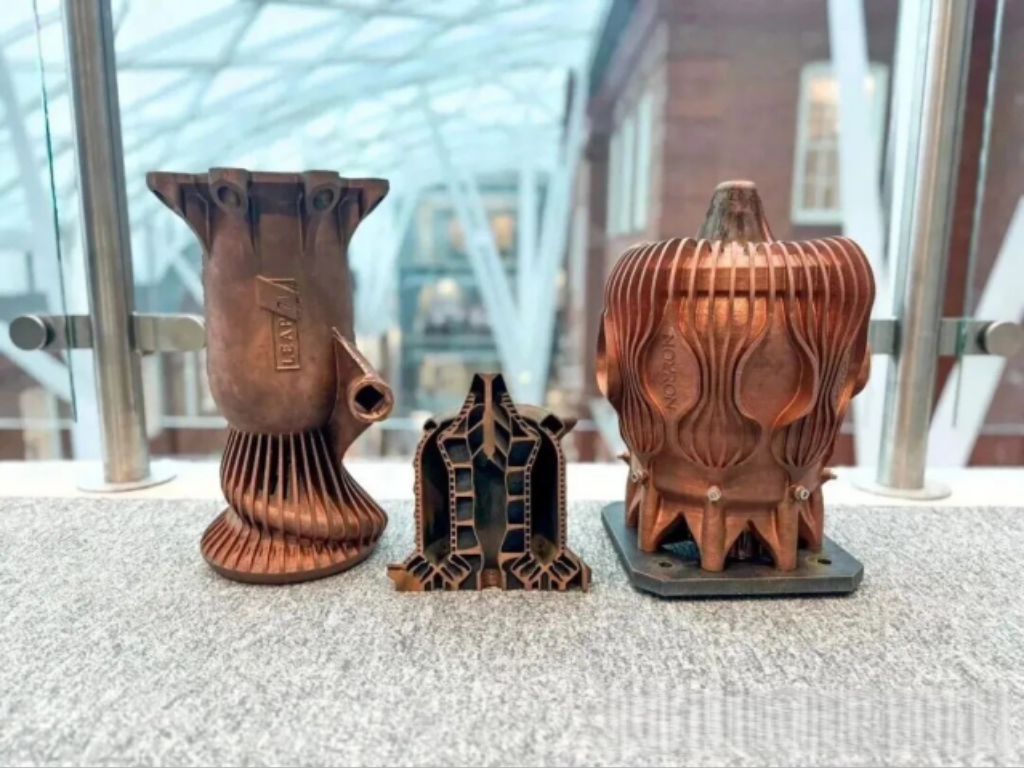
The engine was manufactured by Aconity3D, which provided the manufacturing service using their AconityTWO 3D printer. The printer’s process parameters were systematically optimized for the specific product characteristics, aiming to improve surface quality and ensure dimensional accuracy of the internal cooling channels. The entire manufacturing process was tightly controlled to ensure stability, reliability, and repeatability.
The engine was made using CuCr1Zr copper alloy, which offers a combination of excellent thermal conductivity, mechanical strength, and cost advantages. The heat treatment was quickly performed in a vacuum environment to prevent surface oxidation and enhance the material’s microstructure and performance.
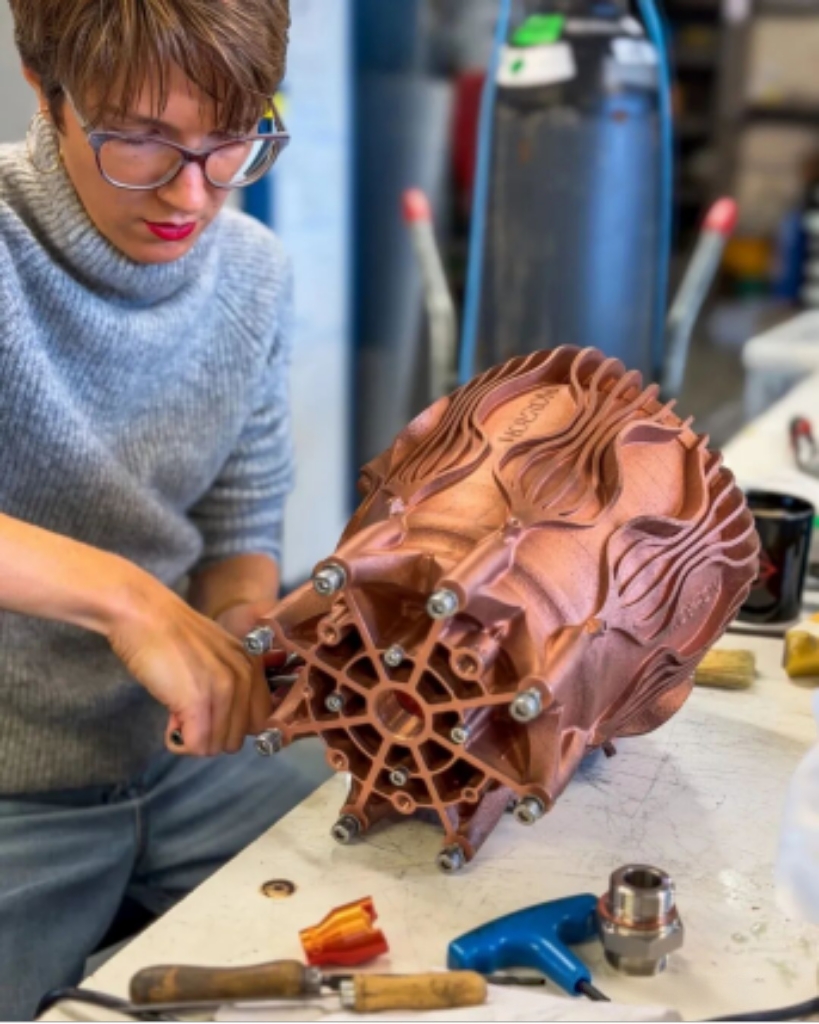
Aconity3D emphasized that all partners in this project worked closely together, reducing technological risks and shortening delivery times, leading to important breakthroughs in testing.
The synergy created by the integration of AI and 3D printing technology has also drawn attention in the domestic aerospace industry. In 2025, the emerging commercial space company, MicroLight Qihang, announced its collaboration with LEAP71 to develop an innovative 3D printed coaxial shear injector.
The combination of AI and 3D printing allowed for a 98% reduction in the number of components, a 70% reduction in development time, and an 80% reduction in costs. This injector is not only the first domestic application of both technologies in the production of liquid rocket engines but also a landmark product that swiftly transforms cutting-edge global “AI + computational engineering” technologies into tangible engineering solutions.
Furthermore, with the intensifying competition in commercial space, it is expected that there will be an increasing number of real-world applications of AI design and 3D printing technology.