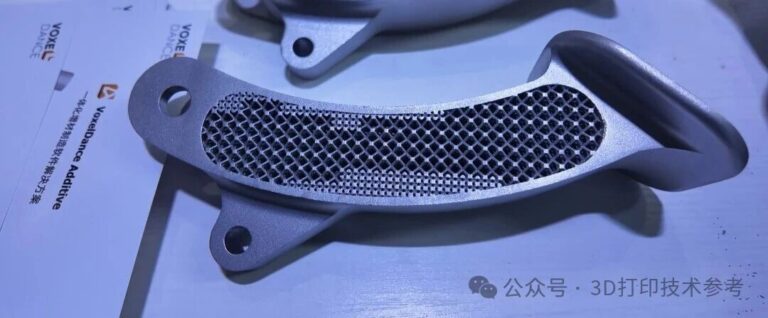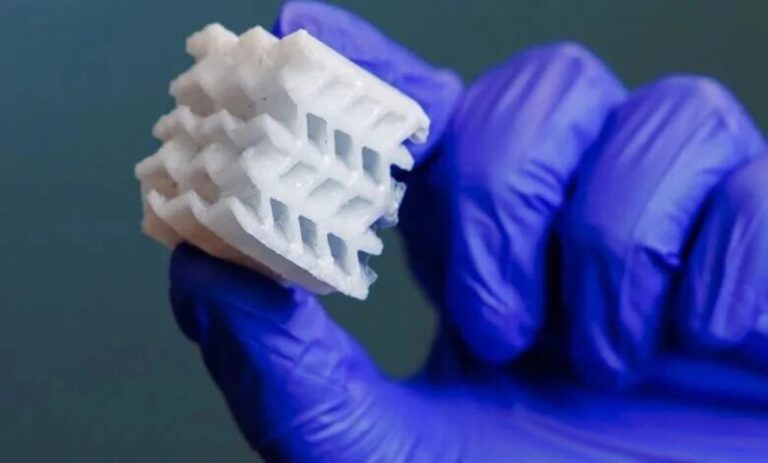
October 9, 2025 – Lausanne, Switzerland — Researchers at the École Polytechnique Fédérale de Lausanne (EPFL) have pioneered a groundbreaking 3D printing method that enables metals and ceramics to “grow” within a water-based hydrogel matrix. This innovative approach marks a major step forward in the development of ultra-dense and intricate composite structures for next-generation energy, biomedical, and sensing applications.
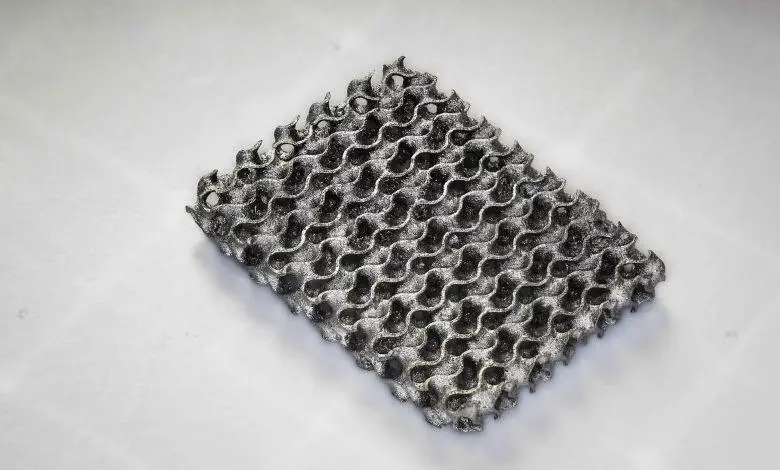
New Hydrogel Templating Method Enables High-Strength Metal–Ceramic 3D Printing
Photopolymerization technology is typically limited to photosensitive polymers, which restricts its practical applications. Although some 3D printing techniques have been developed to convert printed polymers into tougher metals and ceramics, challenges remain.
According to Dr. Daryl Yee, Head of the Laboratory for Materials Chemistry and Processing at EPFL’s School of Engineering,
“Materials produced using these methods often suffer from severe structural defects. They tend to be porous, which greatly reduces their strength, and the parts undergo excessive shrinkage that leads to warping.”
Unlike previous methods, the EPFL team began by constructing a 3D scaffold made of a simple hydrogel, rather than using light to harden a resin preloaded with metal precursors. They then infused this “blank” hydrogel with metal salts, which were subsequently converted through chemical processes into metal-containing nanoparticles that permeated the structure. By repeating this cycle, the researchers were able to produce composite materials with exceptionally high metal concentrations.

Cross-Section of Copper-Infused Hydrogel
After five to ten “growth cycles,” a final heating step burns away the remaining hydrogel, leaving behind a finished product — a metal or ceramic object that retains the exact shape of the original polymer template but with unprecedented density and strength. Because the metal salts are introduced after the hydrogel is fabricated, this technique allows a single hydrogel scaffold to be transformed into a variety of composite, ceramic, or metallic structures.
Dr. Daryl Yee explained,“Our work not only enables the production of high-quality metals and ceramics through a simple and low-cost 3D printing process, but it also highlights a new paradigm in additive manufacturing — one in which material selection occurs after, rather than before, the 3D printing stage.”
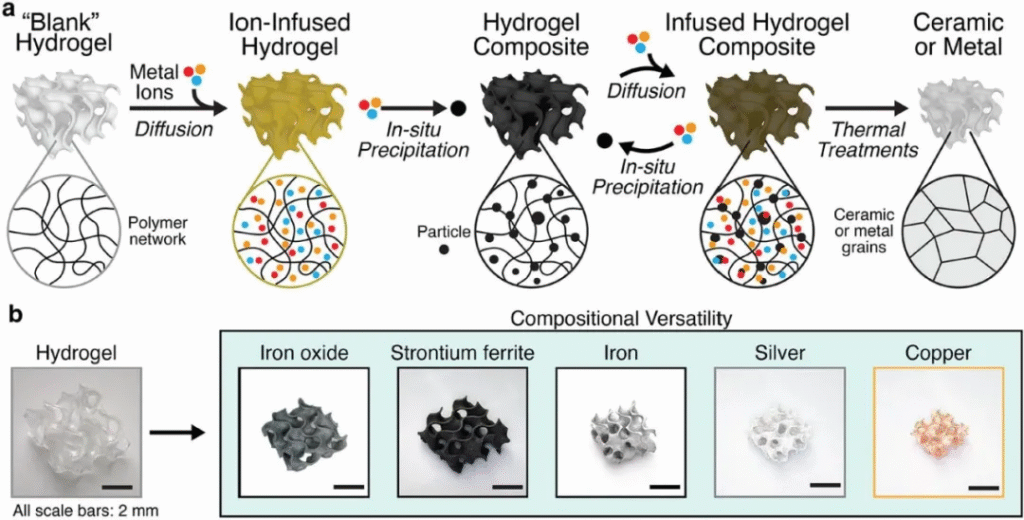
(a) Schematic illustration of the hydrogel infusion and precipitation process for metals and ceramics.
(b) Photographs of metal and metal-oxide parts fabricated using the new method.
3D Printing Achieves 20× Strength Increase and Shrinkage Reduced to 20%
In this study, the research team fabricated intricate mathematical lattice structures, known as gyroids, using iron, silver, and copper to demonstrate the ability of their technique to produce strong yet complex geometries. To evaluate the material’s performance, they applied increasing pressure to the gyroid samples using a universal testing machine.
Dr. Daryl Yee remarked,“Our work highlights a new paradigm in additive manufacturing — one in which material selection occurs after, rather than before, the 3D printing process.”
Co-author Ji Yiming added,“Compared to materials produced by previous methods, our printed structures can withstand 20 times greater pressure, while exhibiting a shrinkage rate of only 20%, versus 60–90% in conventional approaches.”
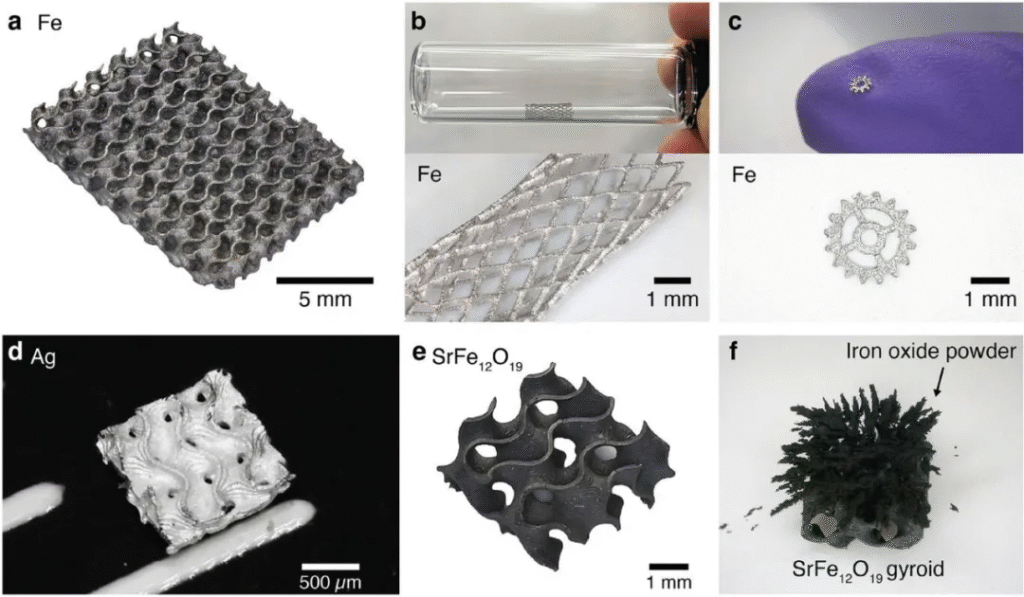
Optical Images of Centimeter- and Millimeter-Scale Samples Prepared via the Infusion–Precipitation Method
The research team noted that their technique is particularly valuable for fabricating advanced 3D structures that must combine strength, light weight, and geometric complexity — qualities essential for next-generation sensors, biomedical devices, and energy conversion or storage systems.
For example, metallic catalysts are critical for reactions that convert chemical energy into electrical energy. Other potential applications include high–surface-area metallic structures with superior cooling capabilities for energy technologies and thermal management systems.