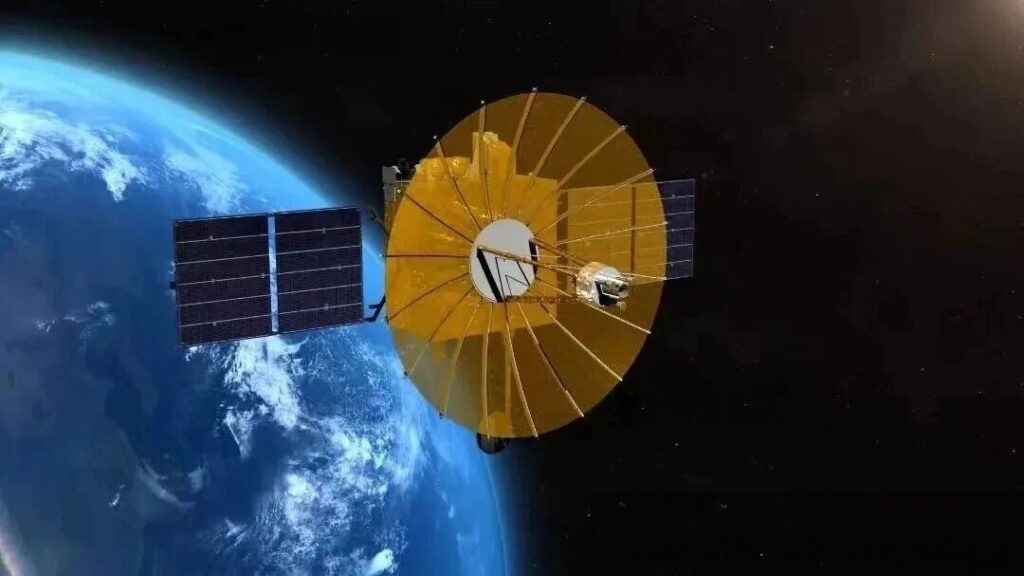
A 450 million yuan “Liangxi Constellation” 3D printing satellite manufacturing project in 2025 may provide the answer. This is a potential application scenario that is either already exploding or about to. Such a scale will drive market growth across multiple sectors, including 3D printing materials, equipment, services, and design.
Coincidentally, in January 2026, South Korean aerospace company Innospace announced the successful low-suspension, support-free 3D printing of Ti6Al4V titanium alloy pressure vessels. These reports prompted the author to make a connection—the integrated support-free or low-support 3D printing of satellite tanks or containers could potentially become a typical application in large-scale satellite manufacturing.
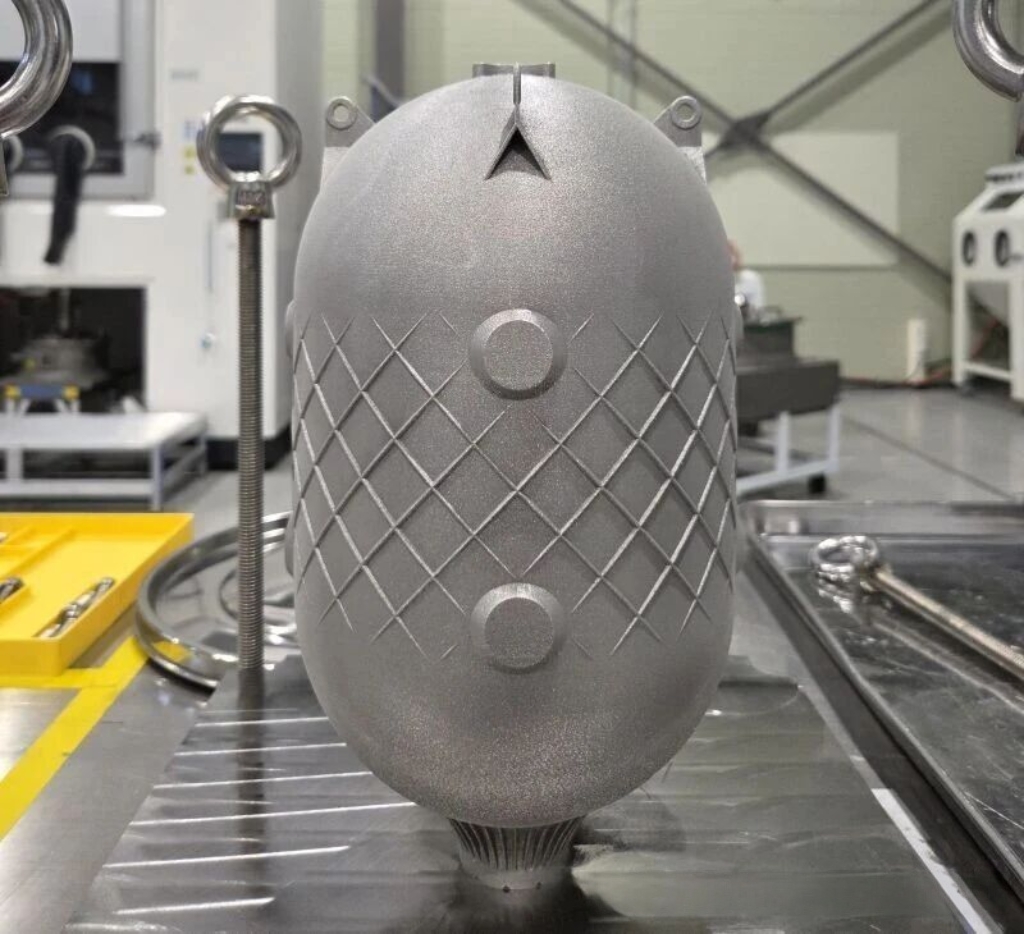
Fuel Tanks 3D Printed by Innospace
3D Printed Satellite Fuel Tanks: Domestic and International Application Cases
As early as around 2018, users approached me with the request to directly print sealed fuel tanks. At that time, the technology simply wasn’t advanced enough to achieve this, and most domestic equipment manufacturers could not deliver such a solution. However, abroad, the concept of support-free metal printing gained significant attention, which later became a major driver for the rapid development of this technology in the following years.
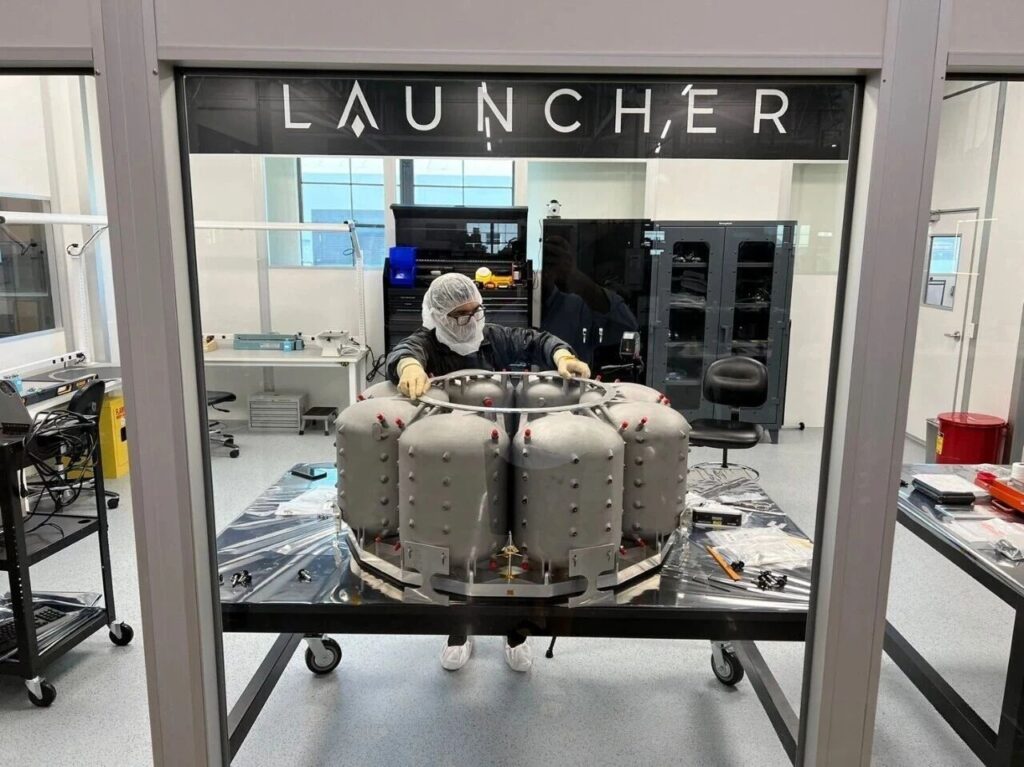
In January 2023, the first batch of support-free metal 3D printed sealed fuel tanks were sent to space. Velo3D manufactured 8 titanium alloy fuel tanks for Launcher’s Orbiter satellite transport vehicle. This also indicates that the related technological groundwork was completed in 2022.
China’s First 3D Printed Satellite Fuel Tank in-Orbit Application Took Place in March 2024. This fuel tank was jointly developed by the 801 Institute of China Aerospace Science and Technology Corporation (CASTC) and the 800 Institute of CASTC. Platina provided equipment support for the production of this tank.
The fuel tank was made using integrated aluminum alloy 3D printing. According to CCTV News, the research and development team overcame several key technical challenges. Not only were all components highly integrated and installed on the fuel tank, but the internal 3D printed channels also connected the components without the need for traditional conduit connections. This innovation significantly shortened the development cycle and effectively reduced costs.
Domestic Examples of Unsupported Metal 3D Printed Fuel Tanks
It is important to note that a closed structure like a fuel tank with piping does not necessarily require low overhang angles for 3D printing. Instead, internal structural optimization can be used to avoid the need for supports.
However, exploring the limits of this process will continue to drive 3D printing technology toward broader application scenarios. Regarding domestic examples of unsupported printing for fuel tanks, three cases have been identified:
Huashu High-Tech Unsupported 3D Printed Fuel Tank
Huashu High-Tech’s low-support metal 3D printing technology has been widely applied in batch production, with typical applications including fuel tanks, closed impellers, and more. The maximum workpiece size exceeds 450mm. The materials used include titanium alloys, high-temperature alloys, aluminum alloys, and stainless steel.
At the 2024 TCT Asia exhibition, Huashu High-Tech showcased its unsupported 3D printed fuel tanks. The company stated that it uses an adaptive intelligent scanning strategy to precisely control energy input and local heat on the part. This improves the forming capability significantly compared to traditional scanning techniques, while ensuring the part’s density.
With this technology, Huashu High-Tech overcame the technical challenges of forming difficult structures, such as inverted cone shapes and horizontal round holes. They successfully achieved infinite height forming of inverted cone structures with a 20°-25° tilt angle and one-piece forming of horizontal round holes with a maximum diameter of Φ50mm without the need for supports.
Rongsu Technology, a leading provider of metal wire feed additive manufacturing solutions in China, has achieved unsupported metal 3D printing through multi-axis motion. The company showcased scaled-down models of 316L stainless steel fuel tanks and large aerospace liquid oxygen tanks made with arc 3D printing at the exhibition. These demonstrations highlight that the manufacturing of fuel tanks is not limited to laser powder bed fusion processes alone.
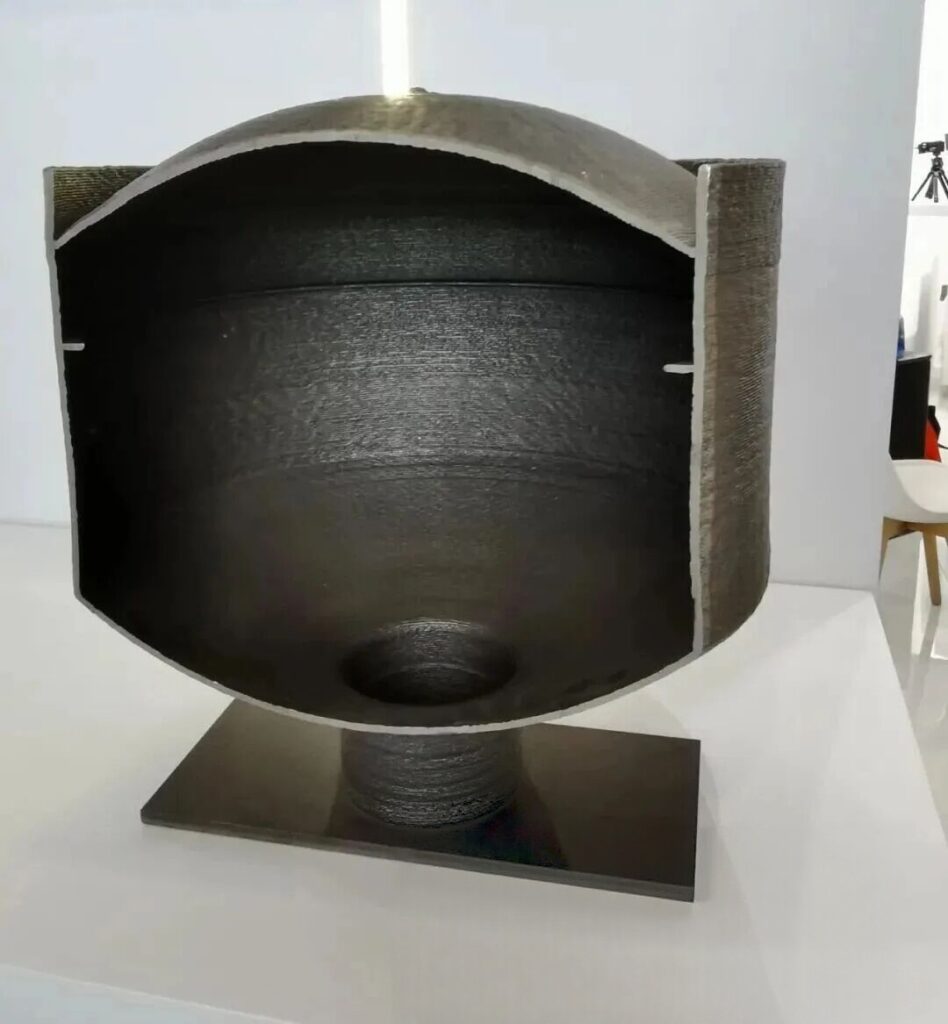
Rongsu Technology’s Arc 3D Printed Fuel Tank Scale Model
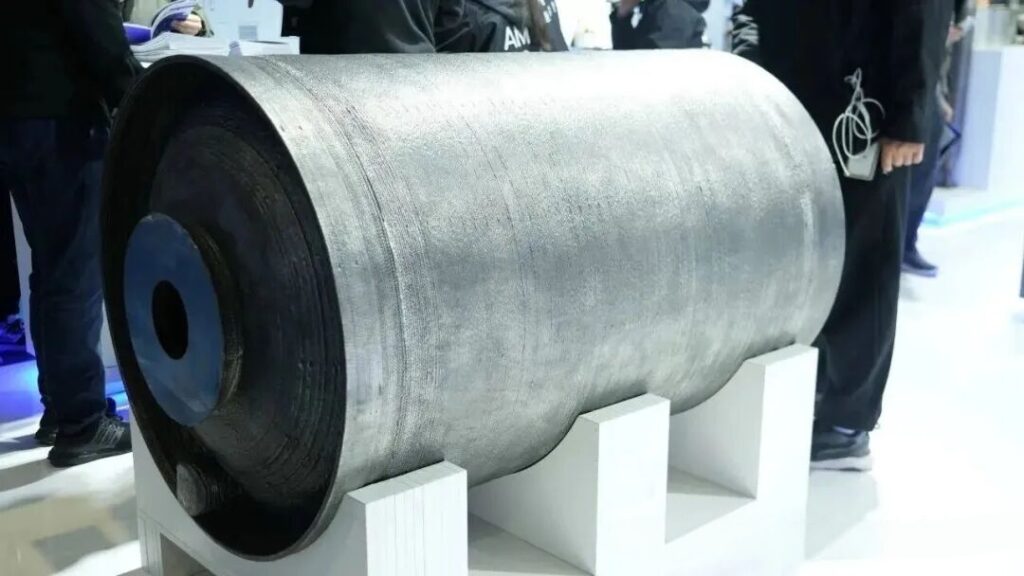
Rongsu Technology’s Arc 3D Printed Aerospace Liquid Oxygen Tank
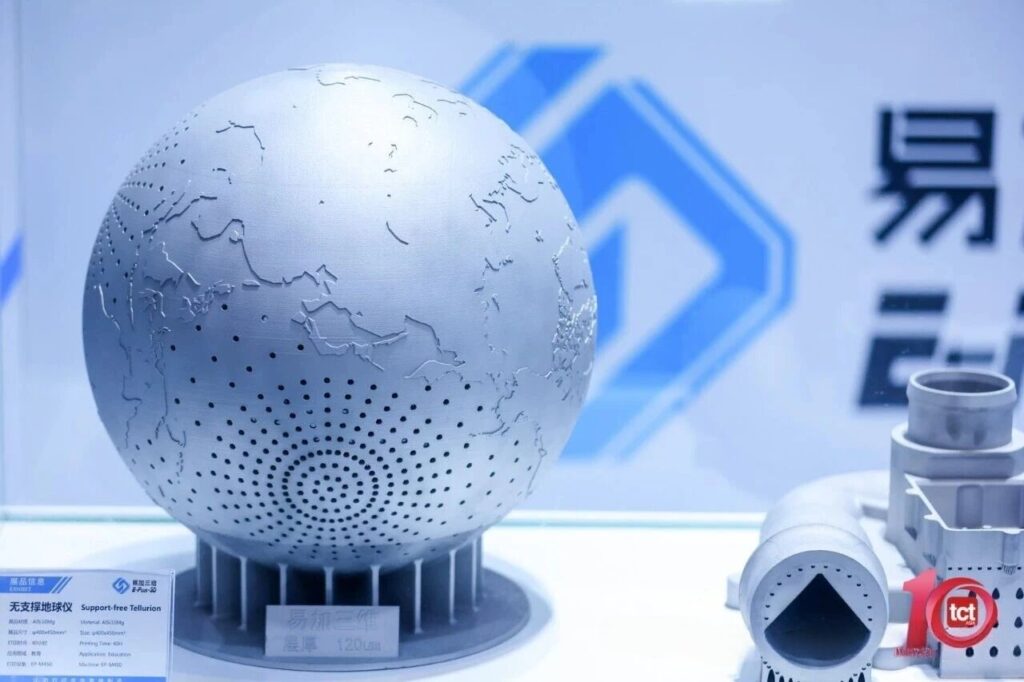
Easy3D displayed support-free 3D printed sphere
At the 2023 TCT Asia exhibition, Easy3D showcased its self-developed support-free metal 3D printing technology, capable of printing common materials such as AlSi10Mg and titanium alloys. A particularly representative part was the support-free printed aluminum alloy globe with a size of φ400×450mm. The structural characteristics of this part suggest the feasibility of achieving support-free printing for fuel tank structures.
Scaling up equipment deployment to support batch 3D printing delivery
Traditionally, satellite fuel tanks must meet stringent requirements for both materials and manufacturing processes to withstand the extreme conditions of space. Aluminum alloys, titanium alloys, and composite materials are the primary materials used, ensuring high strength while prioritizing lightweight design. In terms of manufacturing processes, it has been found that fuel tanks often use a “block forming + welding” method, which is complex, involves welding seams, and impacts reliability and overall precision. If mass production were to be scaled to the tens of thousands, one can imagine the substantial workload involved.

EOS 3D printed support-free fuel tank.
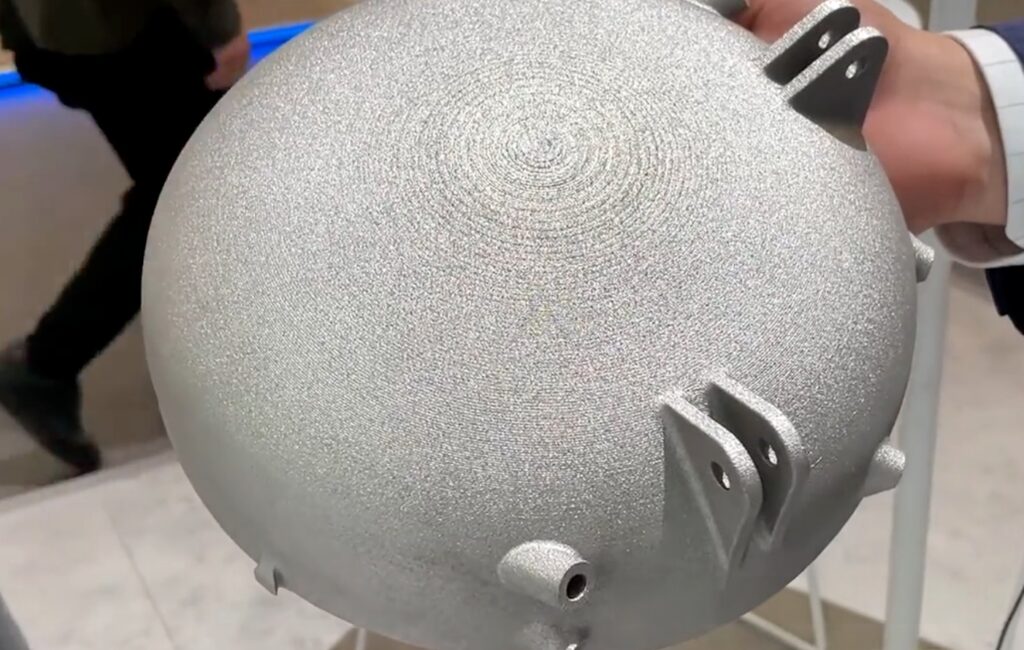
The top surface of the EOS 3D printed support-free fuel tank.
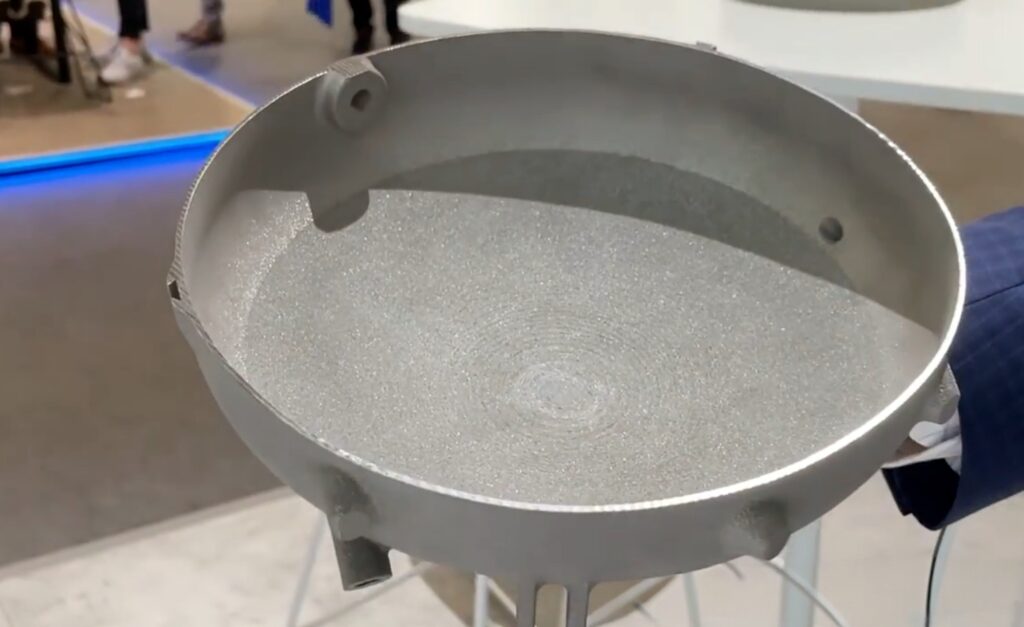
The internal top surface of the EOS 3D printed support-free fuel tank.
Compared to traditional manufacturing methods, 3D printing technology greatly liberates productivity by directly importing model files to produce a product close to the final use, significantly shortening the manufacturing cycle. Additionally, whether it is based on structural design to avoid internal supports or the support-free process, using dozens or even hundreds of 3D printers allows for rapid delivery of large quantities of products in a limited time, making expansion extremely flexible. This demonstrates the tremendous manufacturing advantages of 3D printing technology.