

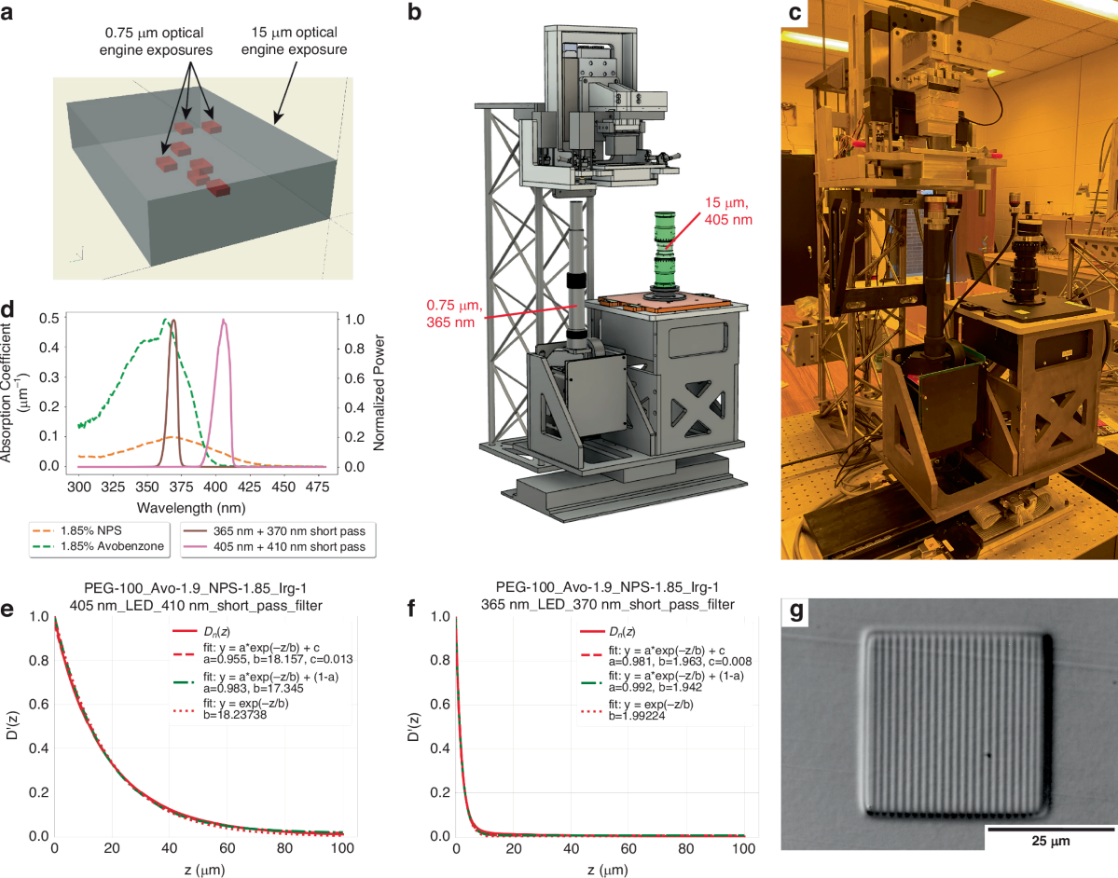
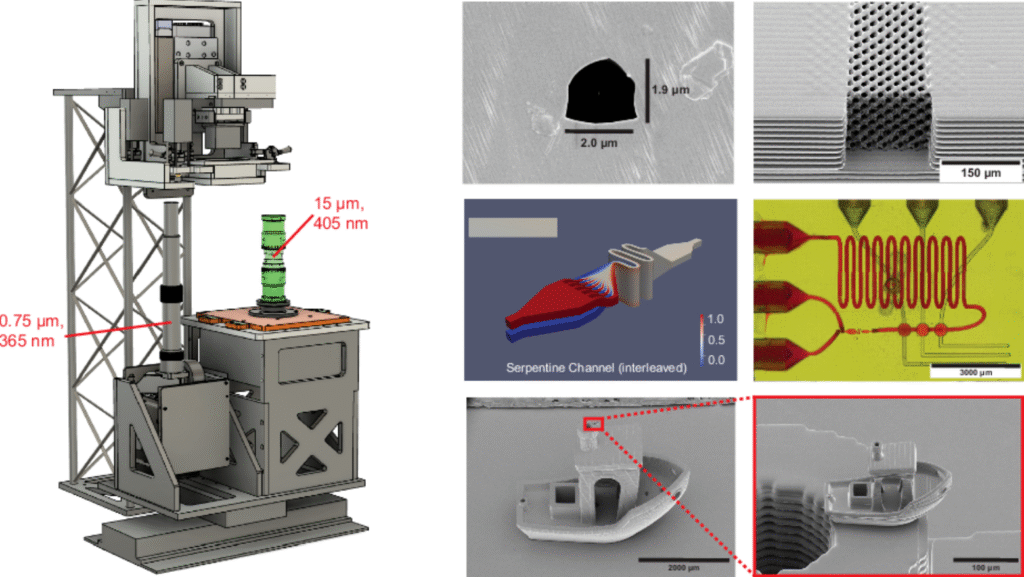
The research team from the University of California, Los Angeles published their latest study in npj Microsystems & Nanoengineering, a journal under Nature. They developed a multi-resolution 3D printing technology capable of fabricating fully enclosed microfluidic channels with a cross-section of only 1.9 × 2.0 micrometers—about 30 times thinner than a human hair—while maintaining a practical printing speed.
This breakthrough could significantly accelerate the miniaturization of technologies in fields such as lab-on-a-chip systems, biomedical diagnostics, and chemical analysis.
Why Does Microfluidics Require Ultra-High-Precision 3D Printing?
Microfluidic chips are often referred to as “labs on a chip.” They are widely used in applications such as rapid pathogen detection, single-cell analysis, and drug screening. However, traditional fabrication of microfluidic devices relies on photolithography and soft lithography (PDMS molding) processes, which are complex, expensive, and difficult to use for creating fully enclosed three-dimensional microchannels.
Although 3D printing—especially Digital Light Processing stereolithography (DLP-SLA)—offers advantages such as rapid fabrication, lower cost, and true 3D manufacturing, it has long faced a fundamental limitation:
- Higher resolution usually means a smaller printable area
- Faster printing often results in lower precision
In current commercial DLP 3D printers, the smallest achievable microfluidic channel size is typically around 20 micrometers, which still falls short of the requirements for many advanced applications.
Dual Optical Engine: One Printer, Two Resolutions
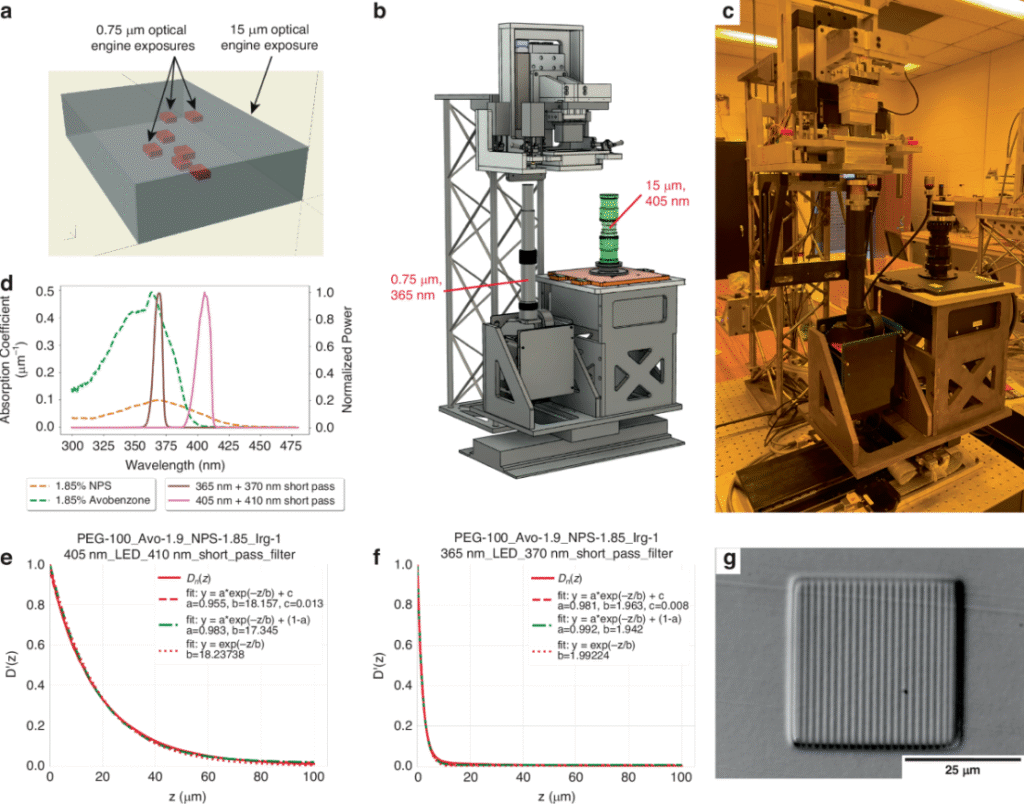
Researchers at University of California, Los Angeles addressed this challenge by developing a dual-optical-engine multi-resolution DLP 3D printing system. The key innovation is the integration of two optical engines within a single printer, each optimized for a different task.
1. Very High-Resolution Optical Engine (VHROE)
- Pixel pitch: 0.75 μm
- Light source: 365 nm UV LED
- Function: Fabricates micrometer-scale fine structures with extremely high precision.
2. Main Optical Engine (MOE)
- Pixel pitch: 15 μm
- Light source: 405 nm UV LED
- Print area: 38.9 mm × 24.3 mm
- Function: Rapidly builds large structural components of the device.
Both optical engines are mounted on the same XY motion platform and operate cooperatively during a single print job.
- Fine features are printed using the VHROE
- Larger structures are printed using the MOE
This coordinated approach achieves an optimal balance between printing speed and precision, enabling the fabrication of ultra-small microfluidic channels while maintaining practical production efficiency.
Resin Formulation Is the Key: Achieving Multi-Resolution Along the Z-Axis
Using a dual optical engine alone enables multi-resolution printing only in the XY plane. To extend this capability into the Z-axis, the research team at University of California, Los Angeles developed a specially formulated photocurable resin.
The resin contains two ultraviolet absorbers—NPS and avobenzone, allowing it to exhibit dramatically different light penetration depths at two wavelengths:
- 365 nm light (VHROE)
- Resin penetration depth: ~2 μm
- Layer thickness: 1.5 μm per layer
- Enables ultra-thin layers for extremely fine vertical resolution
- 405 nm light (MOE)
- Resin penetration depth: ~20 μm
- Layer thickness: 15 μm per layer
- Enables rapid stacking of thicker layers for larger structures
Through this approach, true multi-resolution printing is achieved along the Z-axis as well:
- Fine structures are built using thin layers
- Large structural regions are printed using thicker layers for speed
This strategy allows the system to maintain both high precision and practical printing efficiency.
Experimental Results: 2-Micron Channels and an Ultra-Compact Mixer
Using this system, the team successfully fabricated fully enclosed microfluidic channels as small as about 2 micrometers. They also demonstrated an ultra-compact microfluidic mixer with a volume of only 17 nanoliters, highlighting the technology’s potential for miniaturized lab-on-a-chip systems and advanced biomedical applications.
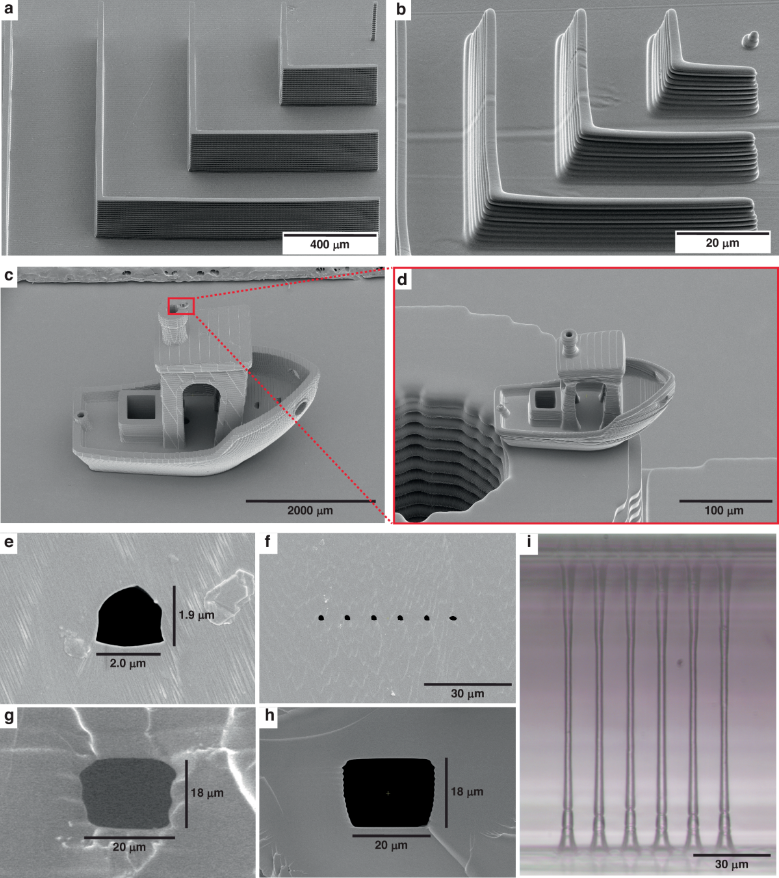
The research team conducted a series of experiments to verify the practical performance of the system:
Minimum Enclosed Channel
A fully enclosed microfluidic channel with a cross-section of 1.9 × 2.0 μm was successfully fabricated. Compared with the team’s 2017 previous work (18 × 20 μm channels), the channel cross-sectional area was reduced by 100 times, setting a new record for DLP-SLA printed microfluidic channels.
Biocage Structure
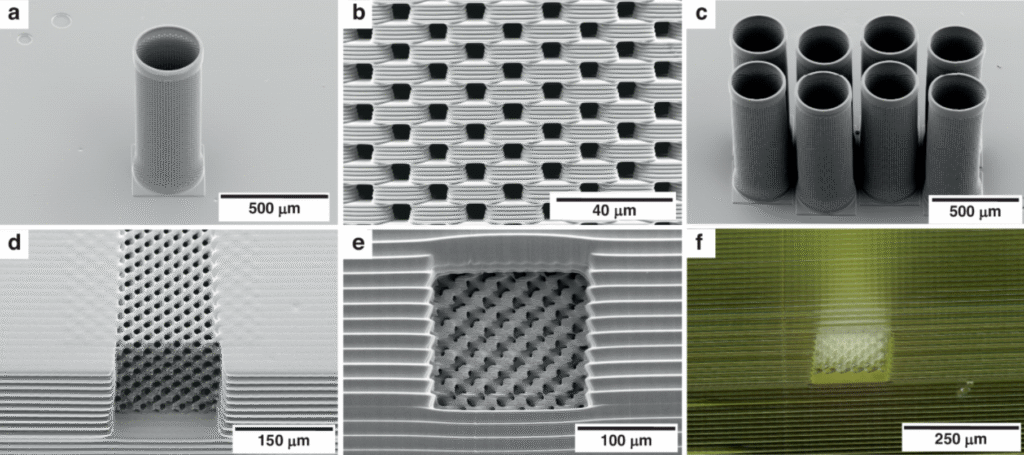
A 3D-printed biocage with a height of 900 μm and an inner diameter of 300 μm was fabricated. The cage walls contain 7 μm pores, making it suitable for cell culture and cell screening applications.
Triply Periodic Minimal Surface (TPMS)
A diamond lattice TPMS structure with 7 μm pores was embedded inside a fully enclosed channel with a cross-section of 150 × 150 μm, demonstrating the system’s ability to fabricate extremely complex three-dimensional microstructures.
Ultra-Compact Microfluidic Mixer
The team printed a microfluidic mixer with a total volume of only 0.017 mm³ (17 nanoliters). The structure required just 21 minutes to print, making it one of the most compact DLP-printed microfluidic mixers reported to date.
Micropumps and Active Mixing: Advancing Microfluidic Control
Beyond passive structures, the research team also demonstrated the fabrication of an active micropump. They produced a peristaltic pump consisting of two membrane valves and one displacement chamber, and tested three different pumping sequence strategies. The optimized four-phase pumping cycle achieved a higher average flow rate, providing a foundation for precise fluid control in lab-on-a-chip systems.
In passive mixing tests, the team combined CFD simulations with experimental validation to design an ultra-compact three-dimensional spiral mixer. This mixer can achieve efficient mixing within an extremely short channel length, highlighting the unique advantage of multi-resolution 3D printing in the Z-axis.