There are quite a number of multi-nozzle FDM 3D printers on the market at present, yet most of them cannot support simultaneous operation of multiple nozzles. Another design integrates two extruders within a standard build volume, enabling them to work in coordination during printing. Products adopting this configuration are relatively rare, but they boast distinct application advantages and usage scenarios.
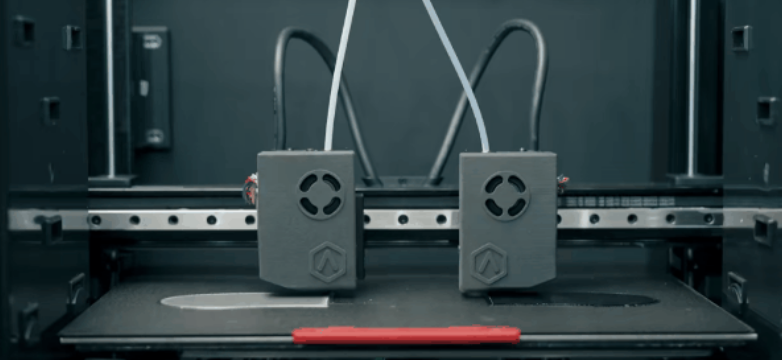
First, let’s talk about the functions. Dual-printhead devices with collaborative operation can not only realize dual-color and dual-material printing on a single part; they can also print two identical models simultaneously, doubling production capacity and greatly boosting manufacturing efficiency. Next is the application scenarios. Paired products such as left and right orthopedic insoles, left and right earphone shells, symmetrical mechanical grippers, and left and right car rearview mirror housings can all be manufactured in parallel with this dual-printhead solution, delivering a noticeable efficiency improvement compared with single-printhead equipment. It presents outstanding efficiency advantages in small orthosis manufacturing factories, 3D printing service farms, as well as the customization of tooling fixtures and medical devices.
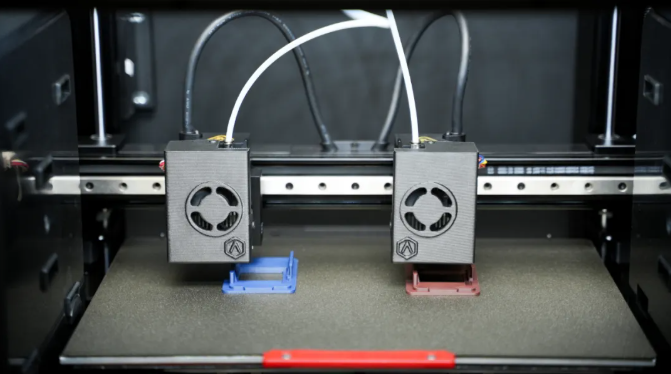
The left and right printheads can print with either the same or different materials.
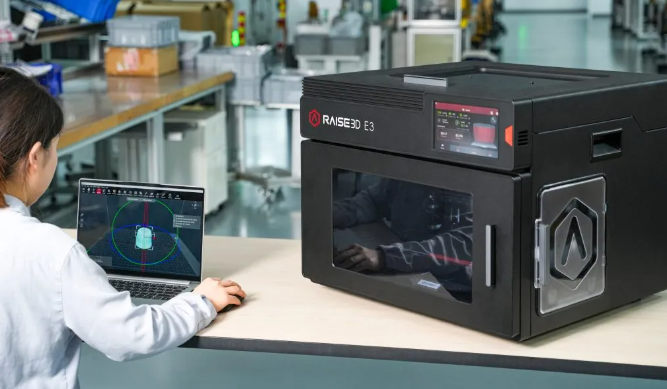
Typical representatives of such products are the E2 and the new-generation E3 3D printers developed by Raise3D.
The printer features a build volume of 330×240×240 mm, with an effective printing size of 295×240×240 mm under dual-nozzle mode. The device supports common materials such as PLA, PETG and ABS, and is also compatible with high-performance filaments including carbon fiber reinforced nylon, as well as flexible materials like TPU.
From the author’s understanding, many industry users have openly stated that this printer delivers outstanding stability during long-term industrial applications. A recently released case further supports this claim. The E3 dual-extruder 3D printer is particularly well-suited for high-efficiency, high-quality and stable production of flexible materials such as TPU. It supports soft elastomers ranging from 80A to 95A Shore hardness, as well as hard elastomers of Shore D hardness grade.
When flexible materials like TPU are printed with desktop FDM 3D printers, nozzle clogging and stringing issues are common, and the yield rate for long-term continuous printing is usually low. This poses a major obstacle to mass production using this technology. The E3 features a feeding system specially optimized for flexible materials. Raise3D has independently developed a dedicated flexible material feeding accessory called FlexFeed. Combined with the structural design of **remote filament feeding plus proximal extrusion**, it effectively improves filament feeding stability, significantly reduces jamming and material accumulation, and enables long-duration, continuous and stable printing.