

A new type of 3D-printable steel alloy has recently been developed, with a composition of Fe–15Cr–3.2Ni–0.8Mn–0.6Cu–0.56Si–0.4Al–0.16C (wt.%).
Compared with mainstream 3D-printed steel alloys, this material does not require complex multi-step heat treatments or expensive alloying elements. After printing, it only needs a simple single-step tempering process to achieve ultra-high strength and high ductility, while also offering excellent corrosion resistance.
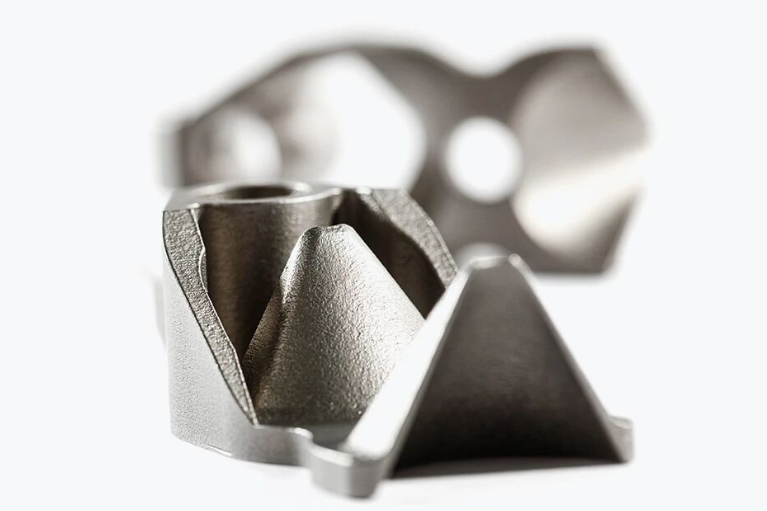
The study points out that traditional 3D-printed ultra-high-strength steels typically rely on expensive elements such as cobalt, molybdenum, or high levels of nickel. Components made from these alloys must undergo complex multi-step heat treatments—including solution treatment, quenching, and multiple tempering cycles—to reach target strength. Even then, they often remain susceptible to corrosion.
Instead of relying on conventional trial-and-error chemistry, the research team adopted a data-driven approach. They compiled 106 datasets of laser 3D-printed high-strength steels from the literature and input the fundamental physicochemical properties of 81 elements—including atomic radius, electronic behavior, and sound velocity—into an interpretable machine learning model. This model was used for multi-objective optimization to identify the optimal alloy composition and a simplified single-step heat treatment process.
The model ultimately identified a composition based on iron and chromium, with small additions of silicon, copper, and aluminum, as an ideal alloy design.
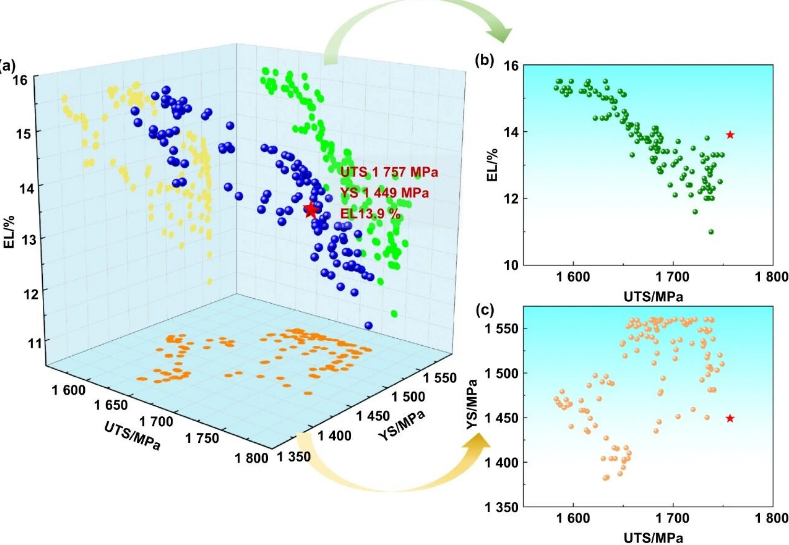
Multi-objective optimization achieved through machine learning
The researchers fabricated the new material using laser directed energy deposition (DED) and then applied a single-step tempering treatment at 480 °C for 6 hours.
Testing results show that the steel can withstand 1713 MPa of stress and exhibits 15.5% elongation before fracture. Compared to its as-printed state, this represents an increase of about 30% in strength and a doubling of ductility.
The study notes that the strength–ductility combination of this new steel significantly surpasses most steels treated with a single tempering step and is comparable to those processed with complex multi-step tempering treatments.
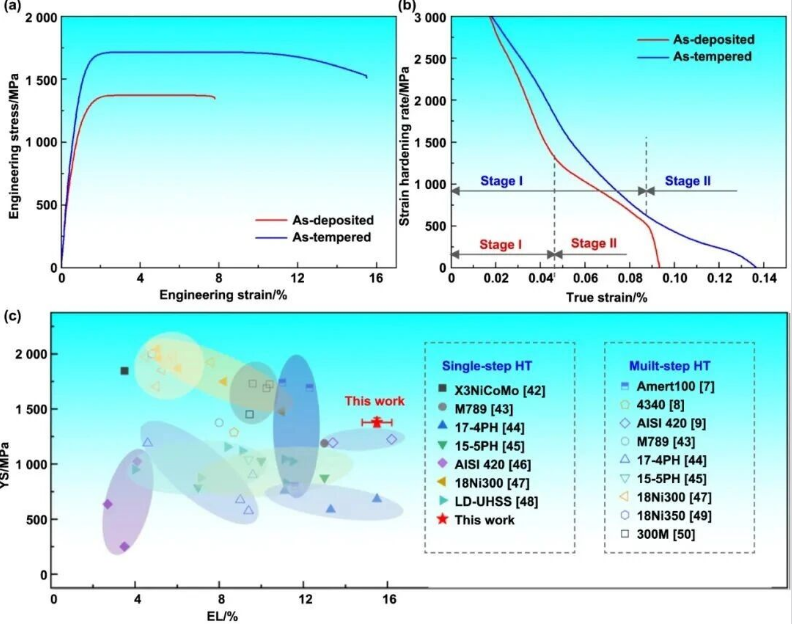
Mechanical properties of as-deposited and tempered samples:
(a) engineering stress–strain curves,
(b) strain hardening rate curves,
(c) comparison of tensile properties of laser additively manufactured steels after single-step and multi-step heat treatments.
The study attributes the combination of ultra-high strength and high ductility to multiple strengthening mechanisms, including solid solution strengthening, precipitation strengthening, and the transformation-induced plasticity (TRIP) effect.
After tempering, the microstructure is mainly composed of lath martensite, along with small amounts of retained austenite, carbides, and nanoscale precipitates such as AlN, NiAl, and ε-Cu.
The alloy also demonstrates superior corrosion resistance compared to conventional steels. In typical steels, carbide formation consumes chromium from the surrounding matrix, creating chromium-depleted regions that are prone to corrosion. In contrast, in this newly developed alloy, the abundant nanoscale ε-Cu and NiAl precipitates tend to repel chromium atoms, redistributing them more uniformly throughout the matrix rather than trapping them in carbides. This reduces chromium depletion and significantly lowers corrosion sensitivity.
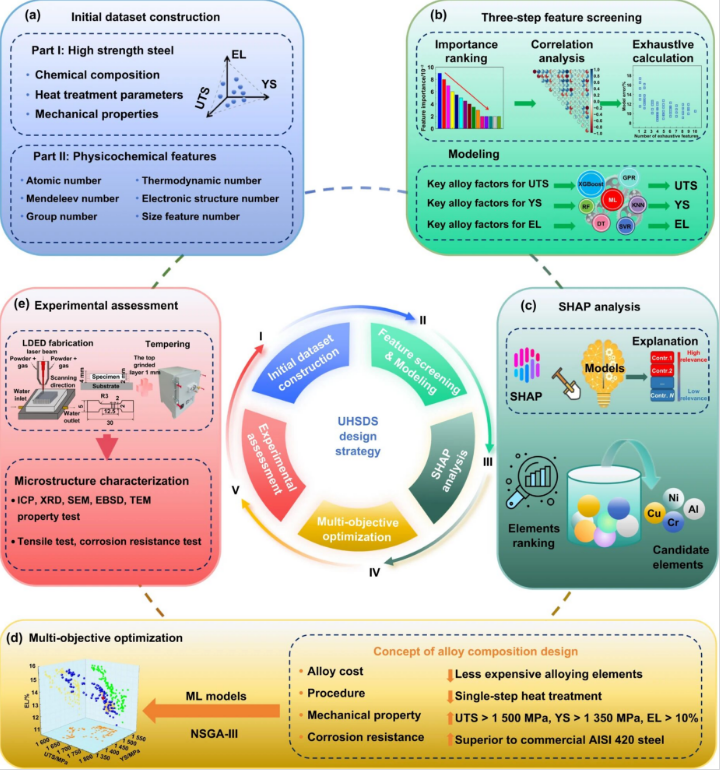
A cost-efficient, short-process, corrosion-resistant UHSDS design strategy
This approach reduces material cost and shortens heat treatment to a single 6-hour step, addressing two long-standing challenges in producing high-performance steels via additive manufacturing.
It enables the production of components with complex geometries and rapid repair capability, meeting urgent needs in key sectors such as aerospace and defense industries. At the same time, it opens a new pathway for the efficient development of ultra-high-strength and high-ductility steels for additive manufacturing.
The research was published in the International Journal of Extreme Manufacturing under the title:
“Interpretable machine learning integrated with physicochemical feature for developing additively manufactured ultra-high strength and ductility steel.”