

Lattice structures are space-filling cellular units without gaps, developed through the repetition of geometric patterns. They have attracted significant attention due to their weight reduction potential and high strength-to-weight ratio in engineering applications.
Before the concept of lattice structures was formally introduced, materials such as honeycombs, as well as open-cell and closed-cell foams, were broadly categorized as cellular or honeycomb structures. However, lattice structures differ significantly from foams and traditional honeycombs in terms of unit cell type, geometry, size, and mechanical properties.
In foam structures, cell shapes are random, and the orientation of cell walls in space lacks a fixed pattern. Some studies provide a clearer definition of metallic foams, describing them as materials with porosity ranging from 40% to 98%. As a widely occurring type of cellular structure, metallic foam has natural and engineered counterparts found in materials such as cork, cancellous (trabecular) bone, and wood.
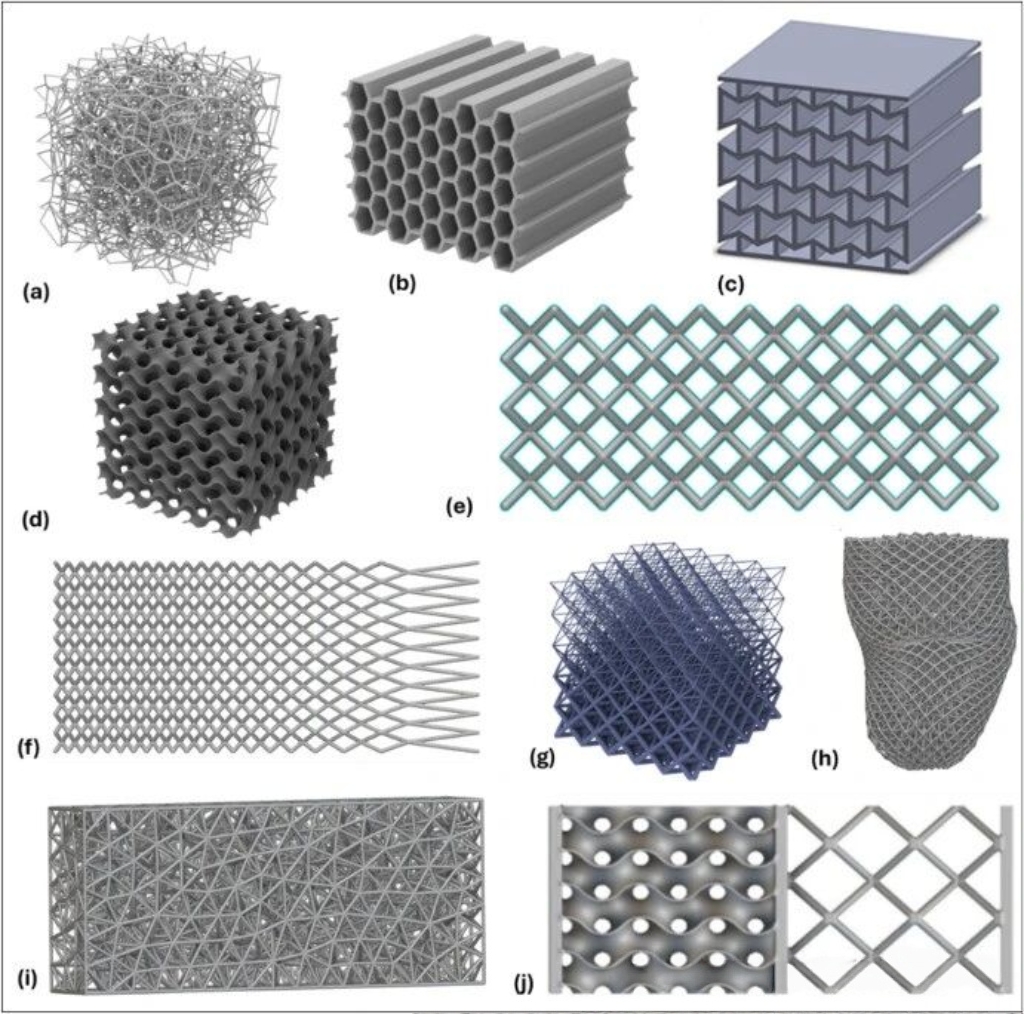
(a) Foam structure
(b) Honeycomb structure
(c) Auxetic structure (negative Poisson’s ratio)
(d) Lattice structure
(e) Periodic lattice structure
(f) Graded by unit cell size
(g) Graded by lattice thickness
(h) Conformal lattice
(i) Random lattice structure
(j) Hybrid lattice
In contrast, honeycomb structures are characterized by extruded cells with uniform shape and identical size. Based on the repetition of unit geometries in a two-dimensional plane, they can be classified into tetrahedral, triangular prism, quadrilateral prism, hexagonal prism configurations, and others.
Among these, the auxetic honeycomb subclass—featuring a negative Poisson’s ratio—has attracted significant attention. Unlike conventional honeycomb structures, auxetic structures expand laterally when stretched. This unique deformation behavior enhances shear modulus, fracture toughness, and indentation resistance compared to traditional honeycombs.
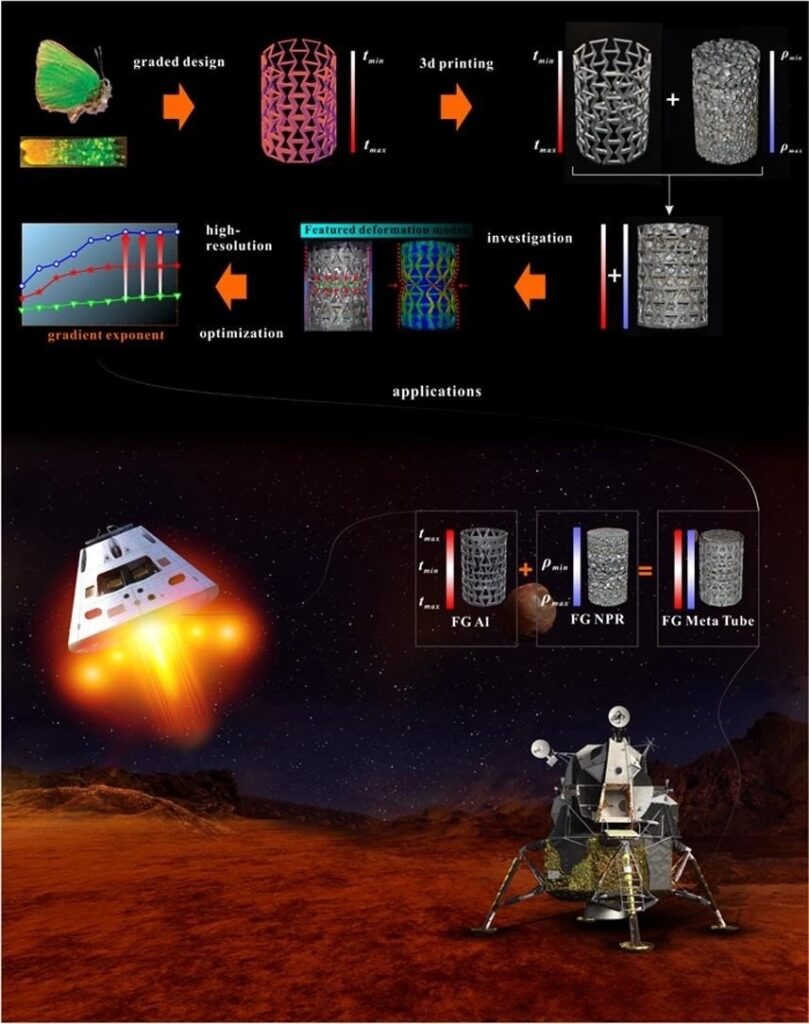
On the other hand, lattice structures are architectural configurations formed by arranging unit cells composed of edges and faces within three-dimensional space.
Based on how unit cells are organized in the 3D design space, lattice structures can be further classified into periodic structures and pseudo-periodic lattice structures.
In periodic structures, unit cells are arranged without altering their intrinsic properties. In contrast, pseudo-periodic lattice structures involve variations in unit cell characteristics such as type, size, or thickness.
Changes in unit size and thickness are commonly referred to as size grading and thickness grading, respectively. Size grading involves a replication pattern in which the dimensions of the unit cells gradually vary along a specified direction, while the strut or wall thickness remains constant. Conversely, in thickness grading, the unit cell size remains unchanged, but the thickness of the structural elements varies.
Gradients can also be achieved through combined variations in cell size, cell type, and element thickness, enabling more complex functional performance tailoring.
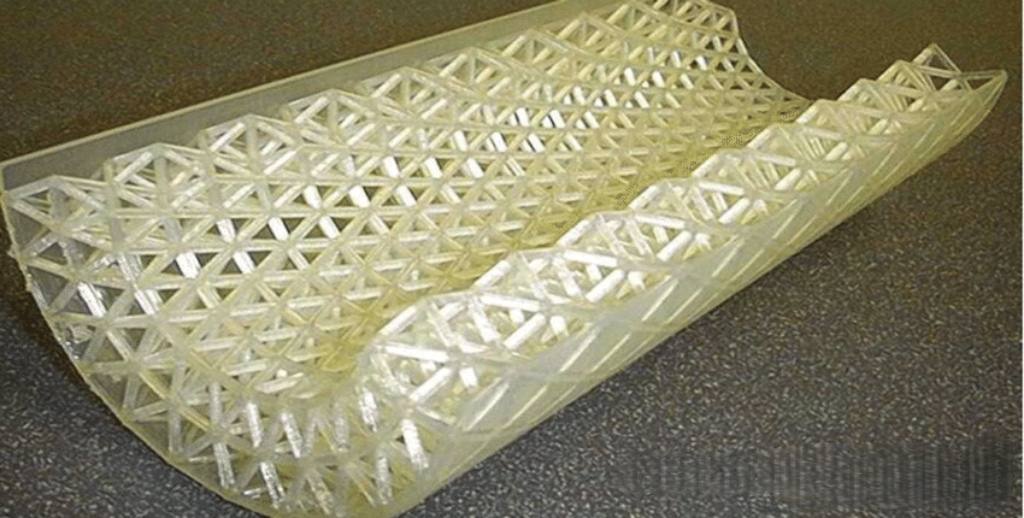
Conformal Lattice Structures
Conformal lattice structures are characterized by non-uniform variations in cell length and shape, enabling the replication pattern to follow the boundaries of a component. This allows the lattice to adapt closely to complex geometries rather than maintaining a strictly uniform repetition.
In addition, random patterns, also known as random lattice structures, are characterized by cells or struts arranged in an overall periodic framework but exhibiting random variations in size, shape, and orientation. These structures should not be confused with random foams, which consist of irregularly shaped cells or voids distributed within a solid matrix.
Another category is the hybrid lattice structure, in which different types of unit cells are combined within a single design to achieve specific mechanical or functional performance targets.

In addition, the literature outlines several commonly used unit cell topologies in additive manufacturing, broadly categorized into strut-based and surface-based lattice structures.
In strut-based structures, as widely discussed in prior studies, nodes located at the vertices or edges of unit cells (and sometimes within the cell interior) are connected by slender, straight elements commonly referred to as struts or beams. These unit cells can exist in both solid and hollow truss variants and encompass a variety of geometries, including simple cubic (SC), body-centered cubic (BCC), face-centered cubic (FCC), and octet truss configurations.
For surface-based unit cells, two primary types can be distinguished: plate-based lattices and triply periodic minimal surface (TPMS) cells. Plate-based lattices consist of two-dimensional planar layers arranged to form three-dimensional structures. Common planar geometries used in 3D printing include lattice configurations with hexagonal or triangular unit cells. Compared with beam-based lattices, plate-based structures are generally stiffer, but they are also heavier and more challenging to manufacture using additive processes.
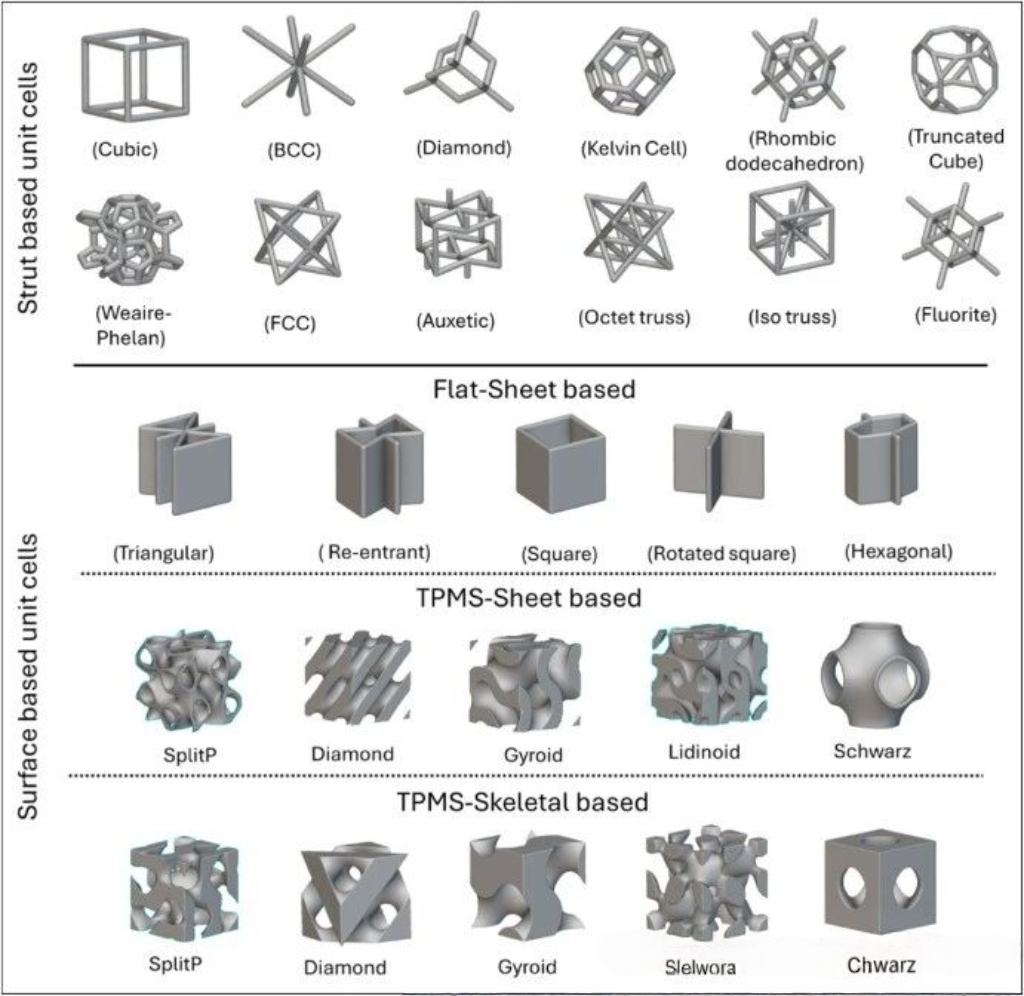
Strut-Based and Surface-Based Unit Cells
On the other hand, triply periodic minimal surface (TPMS) unit cells have attracted widespread attention because their boundary surfaces exhibit zero mean curvature at every point. This type of design is often inspired by biological structures.
Due to their unique geometric characteristics, TPMS structures enable a range of surface-related properties, including manufacturability, fluid permeability, electrical conductivity, and thermal conductivity. As a result, they are particularly significant in the development of functionally graded structures.
Mathematically, TPMS are non-self-intersecting surfaces that form periodic three-dimensional patterns while locally minimizing surface area. These surfaces partition space into continuous interconnected domains and can be generated using level-set techniques based on harmonic functions.